

First-Party Data Theater
Having 1P data and owning it are two different things. The Publicis–LiveRamp deal shows the gap where brands lose control of their audience, decision loop, and their marketing brain in the Agentic AI.

Having first-party data and owning it are two different things.
Look no further than the recent headlines. Publicis agreed to acquire LiveRamp spending billions to sit precisely in that gap, right between customer data and AI agents.
That one deal exposes the most expensive confusion in marketing: the difference between having data and owning the intelligence built on top of it.
And it matters now more than ever, because we are entering the agentic era where AI agents increasingly influence how people search, compare, decide, and eventually buy. Those agents run on data. The only question is whose.
Here is a strange truth about our industry. First-party data is the most talked-about asset in marketing. Every brand says it has a foundation. Every vendor says it will sell you one. Every agency deck has a slide about it.
Yet, far fewer brands truly control theirs than they think.
The Multibillion-Dollar Tell
In May 2026, Publicis agreed to acquire LiveRamp a data-collaboration and identity company in a deal valued at billions.
Read the reason they gave, in their own words: to accelerate data co-creation for smarter agents.
Sit with that for a second.
One of the largest agency groups on earth just spent billions to own more of the layer where customer records get resolved, matched, enriched, and activated across channels and increasingly handed to AI agents to act on.
Their agents. Their platform. Their intelligence layer.
This is not a villain story. It is a highly strategic move. Publicis’ own logic is revealing: agents built on co-created data can learn from every signal, unlike agents trained on stale, generic data.
Read that again. The most strategic acquirer in advertising just spent billions on a single bet: the signal-to-learning loop is the moat. The only question they didn’t answer for you is who should own that loop them, or you.
It tells you exactly where value is flowing in the agentic era. And it should make every brand ask one deeply uncomfortable question:
If my agency owns the data layer and the agent layer, what do I actually own?
The Sleight of Hand
When a holding company says, “We’ll help you with your first-party data,” it rarely means, “We’ll help you keep it.”
It usually means: bring your data into our platform, let us match and enrich it with other datasets, and activate it through our tools, our workflows, and increasingly, our agents.
That may be highly useful in the short term. But it is not the same as ownership. It is the walled garden you spent a decade trying to escape wearing a new, friendlier badge.
Most of what brands call “first-party data” is just a performance.
Start with the pixel. You run Google Analytics and the Meta Pixel on your site. You watch dashboards fill up. You think: this is my data.
Not exactly. A third-party tag is a collection mechanism, not ownership. Unless you route that data into your own warehouse first, the behavior happened on your site but it was captured by someone else’s script, processed through someone else’s infrastructure, and optimized for someone else’s model.
You are renting your own customer signal back from the company that tagged it.
Now multiply that by the dozens sometimes hundreds of other tags on your checkout page, plus the tag manager you bought just to herd them. That is not a foundation. It is a leak with a dashboard.
The pixel is only the obvious case. Here are the ones that fool even the smartest teams:
“It’s in our CDP.” Your data lives in a vendor’s platform, on their cloud, organized their way. The contract says you own it. Then try to leave with all of it intact the customer profiles, the identity graphs, and everything the system has learned. If those are trapped in a vendor-controlled environment, your ownership is contractual, not operational. Ownership you can’t walk out the door with isn’t ownership it’s a hostage you pay rent on.
“Our agency manages it.” The ad accounts, the audience lists, the historical performance it all sits inside your agency’s logins. Switch partners and watch how much of “your” data leaves with them.
“We have millions of customers on the marketplace.” You sell on Amazon and feel data-rich. But you get reports, not relationships. The platform knows the customer. You know the order number.
“We uploaded our list to build lookalikes.” You handed a copy of your customer list into a walled garden to find similar buyers and the smarter audience built on top is theirs, not yours. You just rented your own customers to train someone else’s model.
Each one feels like a foundation. Each one is just a stage set.
That is first-party data theater: the performance of owning your data without the substance of control.
Here is the twist, though. There is exactly one thing in this whole stack you do own outright: the customer’s consent. They didn’t give it to your tag vendor, your agency, or LiveRamp. They gave it to you — your brand, your relationship, your promise. That permission is the only genuinely first-party asset most brands hold. And the irony writes itself: brands guard consent as a compliance checkbox while leaking the data and decisions it unlocks to everyone else. Consent is the deed. The rest is the house you’ve quietly let someone else live in. (That gap turning consent from a liability you manage into capital you compound is its own essay. Call it Consent Capital; a topic for another day.)
The Fork in the Road
The agentic era forces a decision most brands have been avoiding. There are two roads: rent or own.
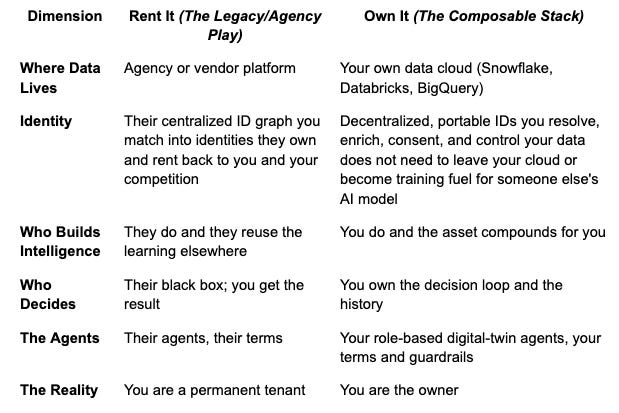
Renting is faster. It always is. That is the trap.
Why Owning the Decision Loop Matters Most
Owning the data is now just table stakes. Anyone can store rows in a warehouse.
The real economic moat is the decision layer built on top of it the continuous loop that captures the complete context of your customer interactions:
The Signal: Who did we reach and why?
The Action: What did we decide to offer them?
The Outcome: What actually happened next?
The Learning: What did the system encode so the next decision is sharper?
That is the loop that compounds. Own that loop and it gets smarter every cycle for you. Rent it, and you are financing your landlord’s AI R&D.
For the last decade-plus, that decision loop got quietly outsourced to the platforms’ black boxes. Your martech built the campaigns. Your adtech ran the media. But the call in the middle what to actually do with both was made for you, behind glass you couldn’t open. In the agentic era, you can’t outsource that anymore, because an AI agent acting on your behalf needs your core logic to execute.
If you rent that intelligence, you have no moat. Your agency can package the same edge and sell it to your competitor next quarter. Your platform can use your signal to improve its macro-model. Your “first-party strategy” becomes raw material for someone else’s machine.
You cannot build an advantage on a brain you do not own.
This is the real, undeniable case for a warehouse-native, composable stack. Your data sits in your cloud. Your intelligence is built on top of it. Your decisions are explainable, auditable, and improvable. Your agents act on your terms.
No landlord. No tollbooth. No theater.
The move isn’t to fire your agency tomorrow or rip out your CDP. It’s to ensure that the data, the decisions, and the learning land in a cloud you control so whatever you rent on top stays replaceable, and the compounding asset stays yours.
The Test
Before you nod along to the next “first-party data” pitch, run one simple test:
Can my AI agent act on my customer data, in my own cloud, using intelligence I own, with a decision history I can audit without asking a third party for permission?
If yes, you have a foundation.
If no, you have first-party data theater.
In the agentic era, the brands sitting in the audience will pay rent to the ones who built the stage and own the learning. Because the real enemy was never agencies, CDPs, or data brokers by themselves.
It is the unowned decision and the learning that should have compounded for you.
First-party data is not the moat. The decision-and-learning loop is.
Thanks for reading.
An LLM helped with research, citations, and light proofreading without changing the content. All ideas, arguments, voice, and em dashes are mine :)
Provocative piece with important implications especially for mid-market brands who may struggle with owning.
Super insightful analysis - thank you for posting!