

Everyone Built First-Party Data Infrastructure. Why Isn't It Powering Advertising?
Brands spent a decade building CDPs, warehouses, identity graphs, and clean rooms. But less than 5% of advertising spend is actually informed by their own audience signals.

Happy Sunday, and Happy Mother’s Day to all the moms reading. Grateful you’re spending part of your day with this.
I’ve spent the past year in conversation with hundreds of CMOs, CDOs, and Brand GMs. Same pattern in every conversation.
Brands have spent the past decade building first-party data infrastructure: CDPs, identity graphs, warehouses, clean rooms, customer 360s. On top of that, the average enterprise now runs 100+ martech and adtech tools: campaign managers, journey orchestrators, attribution platforms, AI copilots, and now agents.
I was part of that build. As an early CDP category pioneer, I helped shape the first-party-led growth playbook.
Here’s what keeps surfacing:
Advertising - the single largest line in the marketing budget, leverages only about 5% of the first-party data brands have spent a decade investing in.
The infrastructure is built. The activation isn’t.
ROAS, CAC, and match rate still matter. But they’re downstream symptoms. The upstream question is AAR — Active 1P Activation Rate: the share of media spend where your own customer signals (LTV, churn, intent, lifecycle, deal sensitivity) actually change a media decision - audience, bid, frequency, creative, or suppression. The real question isn’t “do we have first-party data?” It’s: Did that data change the decision?
In our recent enterprise audits, most brands land below 5%. My broader market estimate is 5–8%.
What does that look like in dollars? For a $20B specialty retailer at ~9% marketing-to-revenue the kind of brand-owned customer relationship you see at a Nike, Lululemon, or Sephora - that means ~$1.8B in marketing → ~$540M paid media → ~$27M 1P-informed. ~$513M black-box. Running on the same platform defaults a $1M startup uses.
The 25% ceiling
The architecture brands built was designed to move audiences. Audience is one decision of five. The other four — bid, frequency, creative, suppression — largely sit inside platform black boxes with limited external control. Audience gets exported. Most of the media decision surface remains unreachable by your 1P signal.
And that’s only the supplier side. The demand-side decisions - relevance, trust, urgency, deal sensitivity platforms don’t try to model at all.
This is the inheritance of CDP-era thinking: centralize the data, resolve identity, compute segments, push audiences. It assumes the answer is data movement.
Agentic activation works differently. You don’t centralize all the data. You signal the right system per identity, in flight, without the heavy lift. The architecture is composable, light, and live.
That’s what getting from 25% to 60% requires. Not more CDP. A different layer entirely.
Why the gap persists
The gap isn’t technical. The math is on every dashboard.
It’s organizational.
CMOs and CDOs championed this stack at the last budget review. Asking whether it’s activating is, in some sense, asking whether that case was right. The data team owns the warehouse. The media team owns the spend. Few orgs have anyone accountable for the ground between them.
Every agency, vendor, and reporting line downstream is wired around the architecture already in place.
Which is why most enterprises have audited their CDP, their identity graph, and their attribution model and never audited their AAR.
Where to look
Every dollar of uninformed media traces back to weakness in one of five places:
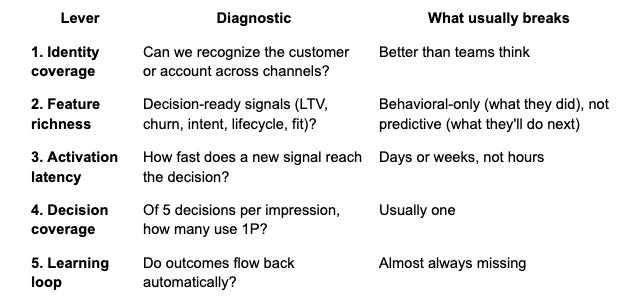
Don’t multiply these. Find the break.
Block 30 minutes with three roles in the room: performance marketing, lifecycle/CRM, data teams. The break is almost always feature richness or decision coverage. Identity is further along than people think. Learning loop closure is universally absent.
What it requires
The window is short. Agent-mediated commerce (Agentic Commerce) is already arriving, and the next 12-18 months will expose which brands have live 1P context and which only have infrastructure.
Whether you sell a $50 product or a $500K contract, the first decision-maker your brand meets is increasingly an agent. An agent asks “the best running shoe for my user.” A high-AAR brand feeds it gait data, fit profile, and purchase history through a clean room. A low-AAR brand shows up as a generic search result.
If your AAR is 5% against human media today, against agent-mediated commerce it’s zero.
AAR is not a reporting metric. It is an operating metric.
The number has three rungs:
Less than 5% is where you are today.
25% is the ceiling of the architecture already in place — because most optimization decisions still sit inside platform black boxes, outside the reach of traditional CDP workflows.
60% is the next state. It requires a composable decision layer between the warehouse and the channels, one that runs the full waterfall: program planning, audience design, in-flight optimization, continuous experimentation, reallocation. Decisions across every phase, every surface. Compounding.
The question isn’t whether you have first-party data.
It’s whether anyone in your organization is willing to ask: did that data change the decision?
Thanks for reading.
An LLM helped with research, citations, and light proofreading without changing the content. All ideas, arguments, voice, and em dashes are mine. :)